|
Laser Refractive Surgery
methods
Why we need wavefront-
guided refractive surgery?
Measurement of the wave
front error of the eye
provides an accurate method
to:
-
Assess the optical
properties of the eye
beyond sphere and
cylinder
-
Evaluate the optical
properties of the eye
-
Provide the necessary
information to design
optical prescriptions
for the eye to minimized
all refractive errors
Conventional Laser
Refractive Surgery:
-
May reduce contrast
acuity.
-
Increase higher order
aberrarions.
-
Increasing with the
magnitude of
refractive
correction.
-
High refractive
corrections, both
myopic (>6.00 D) and
hyperopic (>5.00 D),
can lead to very
high levels of
corneal higher order
aberrations.
-
Decrease night-driving
visual performance.
Higher order aberrations
can cause:
Wavefront-guided Laser
Refractive Surgery provides:
Better contrast sensitivity.
Induces fewer higher order
aberrations.
More effective than Plano
scan in the correction of
total, high order and 3rd
order aberrations.
The most important advantage
of the wavefront-guided
technology is it saves
tissue ablation depth in the
range of 20% or 25%.
Clinically the most useful
methods of evaluating the
success of wavefront-guided
repairs.
-
Subjective improvement
-
Contrast sensitivity
The pre operative evaluation
consisted of:
-
Measurement of
uncorrected visual
acuity (UCVA) and best
spectacle-corrected
visual acuity (BSCVA).
-
Manifest,Subjective and
Cycloplegic refractions.
-
Slit lamp biomicroscopy,
-
Tonometry.
-
Indirect ophthalmoscopy
,
-
Corneal topography ,
-
Ultrasound pachymetry ,
-
Orbscan II 0r Pentacam
-
Aberrometry (Zyoptix
evaluation).
-
Pupillometry
Exclusion criteria are
history of:
-
Previous refractive
procedures.
-
Keratoconus
-
Cataract surgery
-
Diabetes
-
Glaucoma
-
Connective tissue
disorders
-
Retinal disease
-
Pregnant or nursing
period
Conductive Keratoplasty uses
a tiny probe and low heat
radio waves to apply "spots"
around the periphery of the
eye's clear front surface.
This relatively non-invasive
method steepens the cornea,
to provide near vision
correction for people who
are farsighted. CK also can
be used to correct
presbyopia or enhance near
vision for people who have
had LASIK or cataract
surgery. CK received initial
FDA approval in 2002.
Implantable lenses are
another option for vision
correction surgery.
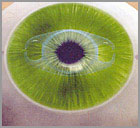
Verisyse phakic IOL from
Advanced Medical Optics.
Implantable Lenses (Visian
ICL and Verisyse), similar
to contact lenses, first
received FDA approval in
2004. These surgically
implanted lenses primarily
are considered appropriate
for higher levels of
nearsightedness. When
implantable lenses are used,
your eye's natural lens is
left in place. Both of these
lenses have a long track
record of use, including
more than 13 years in
Europe.
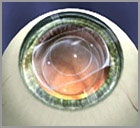
Visian ICL Implantable
Collamer Lens from Staar
Surgical.)
Refractive Lens Exchange is
another non-laser, internal
eye procedure. RLE is much
like cataract surgery. But
instead of removing the
eye's natural lens that has
grown cloudy due to cataract
formation, RLE involves
removing a clear natural
lens and replacing it with
an artificial lens of a
different shape, usually to
reduce or eliminate high
degrees of farsightedness.
RLE also might be considered
as an option for correcting
other types of vision
problems, such as
nearsightedness. But RLE has
a higher risk of
complications, compared with
other vision correction
procedures. For these
reasons, RLE typically is
used only in cases of severe
vision correction needs.
Cataract surgery also can
now be considered a vision
correction procedure. New
lens implants developed for
cataract surgery can
partially restore a person's
near vision in addition to
correcting nearsightedness
and farsightedness. These
lenses, called multifocal
IOLs or accommodating IOLs,
currently are being used by
many cataract surgeons, with
promising results.
|


