|
Refractive Lens Exchange
(Clear Lens Extraction):
(Clear Lens Extraction)
In refractive lens exchange
(RLE) eye surgery, your
eye's natural lens is
replaced with an artificial
one to achieve sharper
focus.
While RLE technically does
not have FDA approval, some
surgeons in certain
circumstances will use the
procedure off label.
This type of use is
perfectly legal and
sometimes a practical option
for elective vision
correction surgery,
particularly for older
people and younger people in
some circumstances.
People who are middle-aged
or older may have the
beginnings of cataracts that
eventually could worsen and
cloud the eye's natural
lens. In time, these
cataracts could become
advanced enough to require
cataract surgery and
replacement of the eye's
clouded lens with an
artificial or intraocular
lens.
If you have early cataracts,
you could choose to have a
refractive lens exchange
instead of waiting for the
cataracts to advance enough
to require cataract surgery.
Artificial (intraocular)
lenses likely can provide
significantly better
uncorrected vision at that
point, especially if you now
require vision correction
with glasses or contact
lenses.
A major appeal of RLE is
represented in newer
accommodating or multifocal
intraocular lenses,
traditionally used in
cataract surgery, with their
ability to restore distance
vision as well as improve
near vision that enables
functions such as computer
use and reading for aging
eyes. Presbyopia affects all
of us beginning at around
age 40, when our eye's
natural lens grows more
rigid and we lose the
ability to focus at all
distances (accommodation).
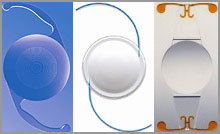
The Alcon AcrySof ReStor,
Advanced Medical Optics
ReZoom, and Bausch & Lomb
Crystalens are three
presbyopia-correcting
intraocular lenses approved
by the U.S. Food and Drug
Administration.
Farsightedness (hyperopia)
higher than +6.00 diopters,
LASIK is generally not
recommended, making
refractive lens exchange a
possible option. If a
traditional intraocular lens
is used, distance vision can
be corrected, but reading
glasses would be needed. If
an accommodating or
multifocal intraocular lens
is used, reading glasses may
be needed infrequently.
While refractive lens
exchange is relatively safe,
you do need to consider that
any surgery has accompanying
risks that should be
discussed in detail with
your eye surgeon. As an
example, the FDA notes that
the chances of a retinal
detachment are slightly
higher in individuals who
have undergone refractive
lens exchange, compared with
the general population.
Otherwise, risks are similar
to what people undergoing
cataract surgery would face.
The procedure for refractive
lens exchange also is
identical to cataract
surgery.Read more about
cataracts and cataract
surgery and
presbyopia-correcting IOLs
|


