|
Macular Degeneration
Treatments
While no current Food and
Drug Administration-approved
macular degeneration
treatment is likely to
completely restore vision
lost to macular
degeneration, some drugs may
be able to preserve or even
improve remaining vision.
Also, certain
investigational treatments
have shown promise for
reversing at least some
vision loss in many AMD
patients. [See also: More
about macular degeneration.]
FDA-Approved Macular
Degeneration Treatments
Lucentis. Approved by the
FDA on June 30, 2006 for
treating the more advanced
or "wet" form of macular
degeneration, Lucentis
(ranibizumab) is a form of
the colorectal cancer
treatment drug, Avastin.
[See also: Investigational
Treatments.] Genentech in
collaboration with Novartis
Ophthalmics is marketing
this new drug, similar in
action to Macugen (see
below) in that it targets
VEGF protein thought to
contribute to development of
AMD by promoting growth of
abnormal blood vessels in
the back of the eye
(retina).
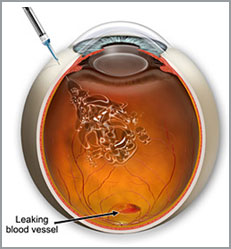
Injections for the "wet"
form of macular degeneration
are made directly into the
eye for treatments including
Macugen, Lucentis and
Avastin.
Lucentis clinical trial
results leading to FDA
approval have been extremely
promising. In late 2005,
Genentech announced results
of one study demonstrating
improved or stable vision in
about 95 percent of
participants compared with
only about 60 percent of
people receiving another
treatment. Vision
improvement with Lucentis
was significant. While only
11 percent of the control
group could see 20/40 or
better following the study,
about 40 percent of Lucentis
patients were able to do so.
In overall study results,
about one-third of patients
undergoing clinical trials
experienced vision
improvement.
Lucentis is administered
through monthly injections
into the eye. An FDA news
release about the approval
says rare adverse reactions
to the drug mainly were
associated with the
injection itself.
Complications of treatment
can include severe
inflammation within the eye
(endophthalmitis), increased
eye pressure (intraocular
pressure), traumatic
cataract or retinal
detachment or tear.
Some eye doctors are
debating whether the
above-mentioned Avastin
should be used in the eye
instead of Lucentis. Avastin
is significantly less
expensive but was not
developed as a macular
degeneration treatment. For
details, read more about the
Lucentis vs. Avastin debate.
Macugen. This newer
treatment for AMD
(pegaptanib sodium) uses a
therapeutic molecule to
attack a protein that causes
abnormal blood vessel growth
in the eye; it was
FDA-approved in December
2004. [See AMD News.] The
drug, developed by Eyetech
Pharmaceuticals and Pfizer,
is administered through
injections into the eye,
with treatments required
every six weeks. In clinical
trials, 33 percent of
patients receiving Macugen
maintained or improved their
vision compared with only 22
percent in the control
group. Macugen also helped
slow the rate of vision loss
for many age related macular
degeneration patients.
Moby's Drug Consult (2006)
reports that fewer than 1
percent of patients
receiving Macugen
experienced serious side
effects such as retinal
detachments or severe
inflammation of interior eye
structures
(endophthalmitis). Less
serious side effects such as
eye floaters and discomfort
occurred in up to 40 percent
of patients.
Visudyne drug treatment
(Photodynamic Therapy or
PDT). Visudyne was the first
drug therapy for treatment
of the wet form of the
disease. It is only for
those patients who have new
blood vessel growth
(neovascularization) under
the retina in a well
defined, distinctive pattern
known as "predominantly
classic." About 40-60
percent of new wet AMD
patients have this form of
macular degeneration,
according to Novartis, the
company that markets
Visudyne (QLT Inc. developed
it).
In this treatment procedure,
the doctor injects Visudyne
into your arm, then
activates the drug as it
passes through the retinal
blood vessels by shining a
non-thermal laser with a
specific wavelength into
your eye. Visudyne is
activated by the laser
light, which produces a
chemical reaction that
destroys abnormal blood
vessels. The procedure is
virtually painless,
according to Novartis.
AREDS Nutritional Formula
For Macular Degeneration
Research suggests that
antioxidant vitamins, such
as beta-carotene (vitamin A)
and vitamins C and E, may
protect the macula from
damage.
AREDS study results
(National Eye Institute)
released in 2001, involving
more than 3,600 people,
found that supplementation
with vitamins C and E,
beta-carotene and zinc
reduced certain patients'
risk of progressing to
advanced AMD by about 28
percent. This number
reflects those patients with
large numbers of
intermediate or large
yellowish deposits (drusen)
on their retinas, but not
those with limited
intermediate drusen or
multiple small drusen.
Because of their findings,
the researchers recommend
that patients at risk of
developing advanced AMD
consider taking antioxidant
and zinc supplements.
Participants received:
The eye care community does
not agree on the benefits of
zinc or antioxidant
supplements: more study is
needed, especially on the
long-term effects of
high-dose supplementation.
High doses of beta carotene
have been associated with an
increased risk of cancer in
smokers. Keep in mind also
that too much of any vitamin
or mineral may affect the
body's ability to absorb
other important nutrients,
so follow your doctor's
advice about dosage.
Read more about how vitamins
and other nutrients can
affect the eyes. Also learn
how you may volunteer to
participate in the AREDS II
study sponsored by the
National Eye Institute. -
M.H.
One in six Visudyne patients
shows improved vision, or
about twice as many patients
as those who do not undergo
Visudyne therapy. Recent
studies also indicate
significant slowing of AMD
progression in many patients
using Visudyne drug
treatment. The reference
book Ophthalmology (Mosby,
2004) reported positive
results of one study in
which 225 eyes received
Visudyne drug treatment,
compared with 114 eyes that
did not. After 24 months,
legal blindness occurred in
28 percent of the Visudyne
group and in 45 percent of
the non-treated group.
Other light-activated drugs
that operate in ways similar
to Visudyne also are under
investigation.
Laser treatment. Laser
photocoagulation can help
wet AMD patients by
destroying or sealing new
blood vessels to prevent
leakage, but no longer is
widely used as a treatment.
The procedure can produce
scars, which are perceived
as blind spots by the
patient. Scientists are
working on ways to reduce
the scarring and are also
studying laser treatments
for dry macular
degeneration, but progress
has been slow.
The reference book
Ophthalmology (Mosby, 2004)
says only about 15-20
percent of patients with the
wet form of AMD have the
type of extremely
distinctive bleeding under
the retina (choroidal
neovascularization or CNV)
that would qualify them for
this type of treatment.
Also, the reference book
notes that photodynamic
therapy (PDT) using Visudyne
drug treatment [see above]
has all but replaced laser
photocoagulation as the
preferred treatment for this
type of macular degeneration
patient.
Please click here to read
about investigational
macular degeneration
treatments that are not yet
FDA-approved.
|


